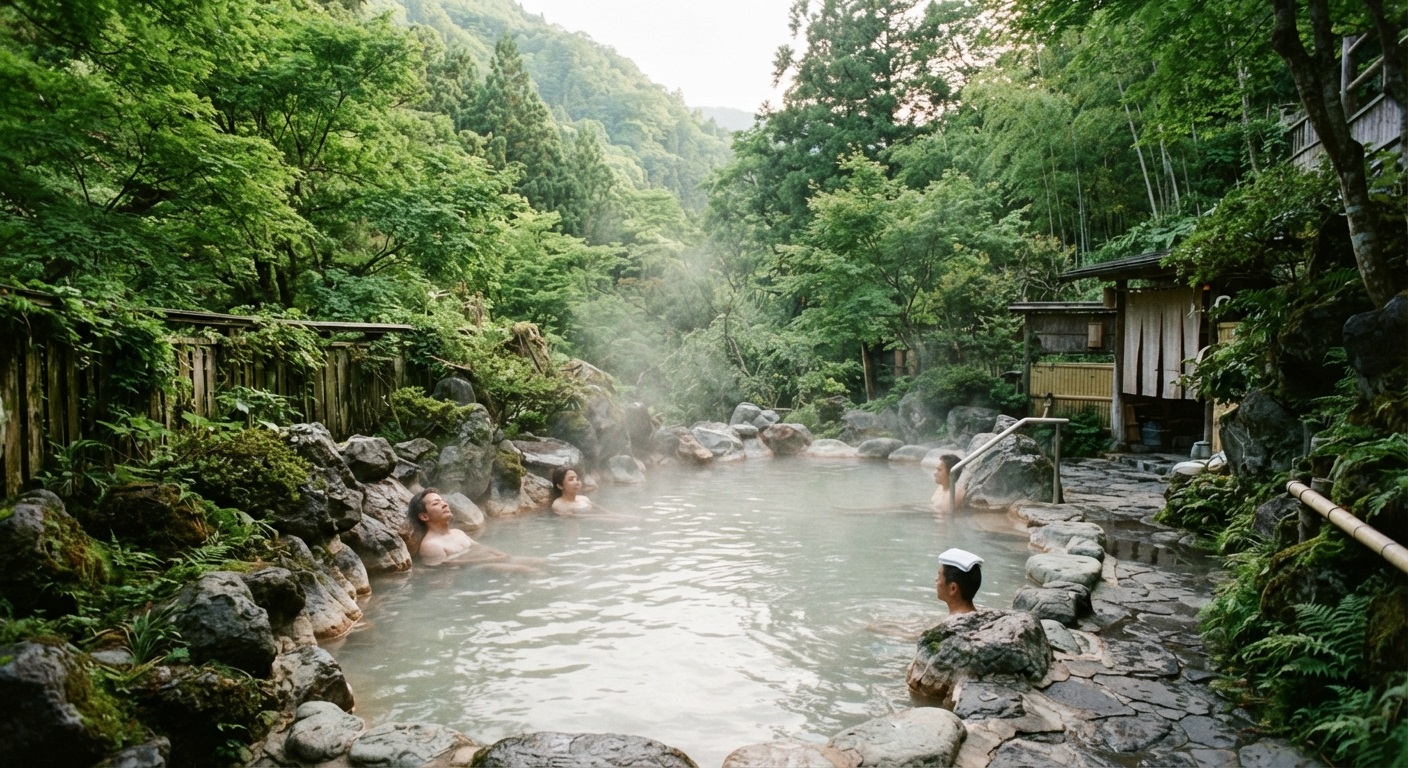
Soaking in a natural hot spring is one of the most Japanese things you can do on a trip here ? and also one of the most intimidating for first-timers. Everyone’s naked, there’s an unspoken rulebook nobody hands you, and if you have a tattoo, you might not even be sure you’re allowed in the door. Here’s everything to know before your first onsen.
Wait, Do I Really Have to Be Naked?
Yes. Swimsuits aren’t worn in the actual bathing water ? bringing any cloth into the water, even your small hand towel, is considered unclean. This trips up almost every first-timer, but it’s genuinely not a big deal once you’re there: everyone is in the same boat, nobody is looking at you the way you think they are, and once you’re actually in the water there’s very little to see anyway.
The Basic Flow
- Pay and get your key. Most onsen give you a locker key, often on a wristband.
- Undress completely in the changing room and leave your clothes in the locker. Bring your small hand towel with you.
- Wash before you get in. This is the one rule that matters more than any other. There will be a row of low stools with handheld showers ? sit down and thoroughly wash your entire body before approaching the bath. Skipping this is the fastest way to get side-eye from regulars.
- Keep your towel out of the water. Fold it up and set it on the side, or rest it on your head ? a genuinely common local habit, not a tourist thing.
- Ease in slowly. The water is hotter than most home baths, often 40?44°C. Don’t dunk your head or splash around.
- No swimming, no diving, no loud conversation. Onsen are for quiet soaking, not the pool.
- Dry off before returning to the changing room. A quick towel-off at the edge of the bath keeps the changing room floor from turning into a hazard.
Tattoos: What’s Actually True in 2026
This is the question that stops more people from going than anything else, so let’s be direct about it.
The historical reason: tattoos in Japan have long been associated with the yakuza, and most onsen banned them outright to keep the environment feeling safe for other bathers ? the same logic that led some facilities to bar members of the same organizations, not tattoos specifically, but visible ink became the easiest proxy to enforce.
Where things actually stand: it’s shifting, but unevenly. Roughly 40% of onsen facilities nationwide have become more flexible with tattoo policies, largely in response to the growing number of tattooed foreign visitors. That flexibility takes a few different forms depending on the facility:
- Full acceptance, no questions asked
- Acceptance if you cover the tattoo with a skin-tone patch (these are sometimes sold at the front desk)
- Private family bath or private room rental, which sidesteps the issue entirely
- Straight-up refusal at the door
There’s no single national rule ? it’s decided facility by facility, so the same tattoo that’s a non-issue at one onsen can get you turned away at another twenty minutes down the road.
What to actually do about it:
- Call or check the facility’s website before you go. This single step prevents 90% of awkward situations. Many ryokan and onsen towns now list their tattoo policy explicitly online.
- Carry a skin-tone cover patch if your tattoo is small enough to conceal ? inexpensive, sold at most drugstores, and accepted almost everywhere that has a “cover it up” policy.
- Book a private onsen (kashikiri-buro) if you want zero uncertainty. Many ryokan offer these for an hourly fee, and it’s just you and whoever you’re traveling with.
- Look at tattoo-friendly onsen towns specifically. Kinosaki Onsen in Hy?go Prefecture is well known for having all seven of its public bathhouses tattoo-friendly, making it one of the easier places to plan a hot spring trip around if you have visible ink.
If you do get turned away somewhere, it’s not usually personal or aimed at you as a tourist ? it’s a blanket house policy. Politely accepting it and moving to the next option is the norm; arguing about it at the front desk isn’t going to change the policy for that one visit.
Onsen vs. Sento ? Quick Distinction
You’ll see both terms while planning. Onsen technically means the water comes from a natural hot spring source, often in a scenic setting, sometimes attached to a ryokan. Sento are public bathhouses using regular heated tap water, more of a neighborhood, everyday-life institution. Etiquette is essentially identical at both ? wash first, no swimsuits, keep the towel out of the water.
A Few More Things Nobody Tells You
- Long hair goes up. Keep it out of the water, either tied up or wrapped in your towel.
- Photography is a hard no in the bathing area, for obvious reasons ? leave your phone in the locker.
- Rinse off after, if you want to, but many onsen fans actually recommend not rinsing right after, so the minerals stay on your skin a little longer.
- Some onsen are gender-separated, some are mixed (konyoku). Mixed ones are increasingly rare and usually clearly marked ? if you’re not looking for that experience specifically, standard gender-separated baths (marked with the kanji 男 for men and 女 for women) are what you’ll encounter almost everywhere.
Once you get past the first-time nerves, an onsen soak ? especially an open-air one (rotenburo) with a mountain or garden view ? tends to become one of the most memorable parts of a Japan trip, not the most stressful one.
Part of our ongoing series on practical things every visitor to Japan should know before they land.

comment