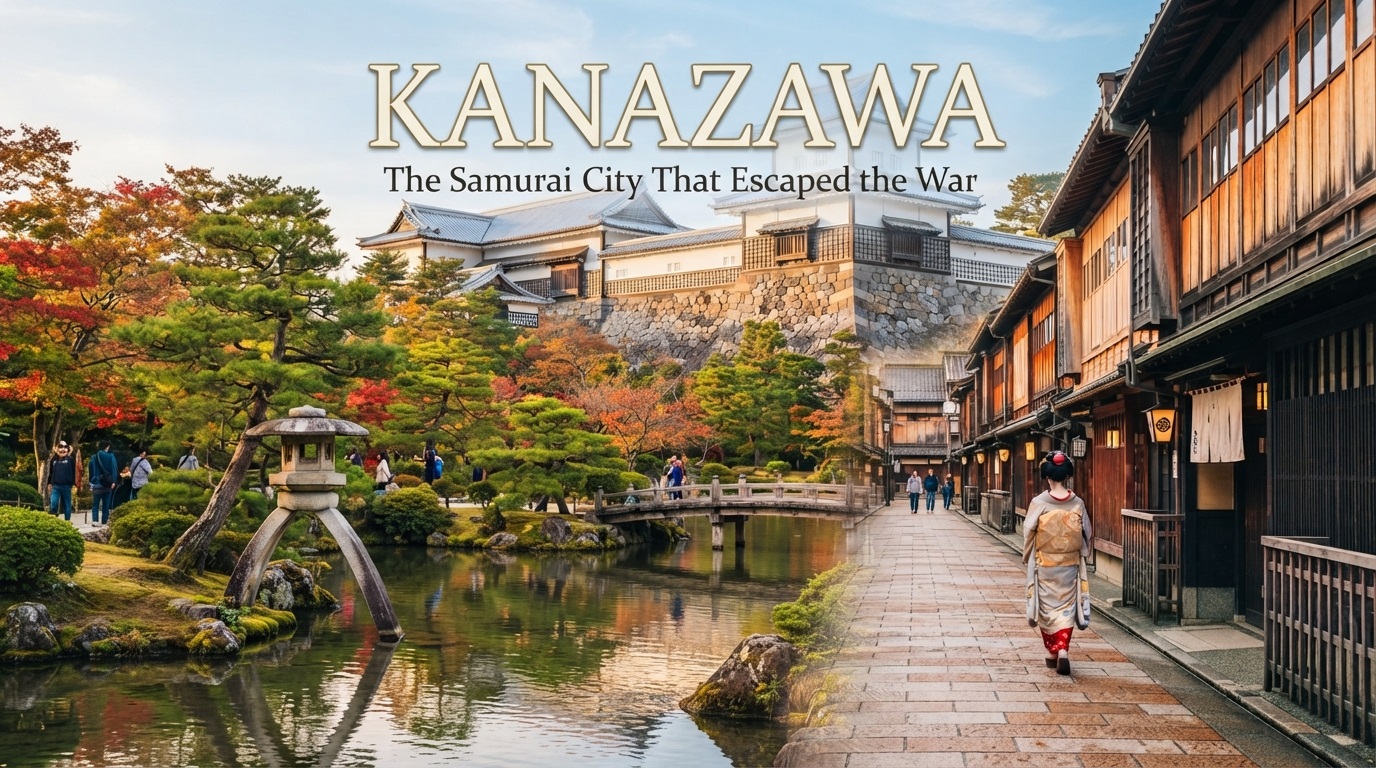
Kyoto is famous for its temples. Osaka is famous for its food. Kanazawa is famous for something quieter but arguably rarer: it’s one of the only major historical cities in Japan that was never bombed during World War II. That accident of history means Kanazawa’s Edo-period street grid, samurai districts, and geisha quarters aren’t reconstructions — they’re the real thing, standing largely where they were built centuries ago.
Add to that a modern reputation as Japan’s craft capital (this city produces roughly 99% of the country’s gold leaf) and a growing profile as one of the best “beyond Tokyo/Kyoto” destinations, and Kanazawa has become one of the more compelling additions to a Japan itinerary — especially for travelers who’ve already done the big-city circuit and want something that feels less filtered through mass tourism.
A City Built by One Family, Over Generations
Where Osaka’s identity comes from merchant culture and Kyoto’s from imperial court life, Kanazawa’s comes from a single powerful clan: the Maeda. As lords of the Kaga domain, the Maeda family ran the wealthiest domain in Japan outside of the shogun’s own territory for over 280 years, from the late 1500s until the end of the Edo period. That stability and wealth is why Kanazawa has so much intact heritage — the Maeda had both the resources and the multi-generational continuity to build slowly and preserve carefully, rather than the boom-and-rebuild cycles seen elsewhere.
Major Sights and the History Behind Them
Kenrokuen Garden
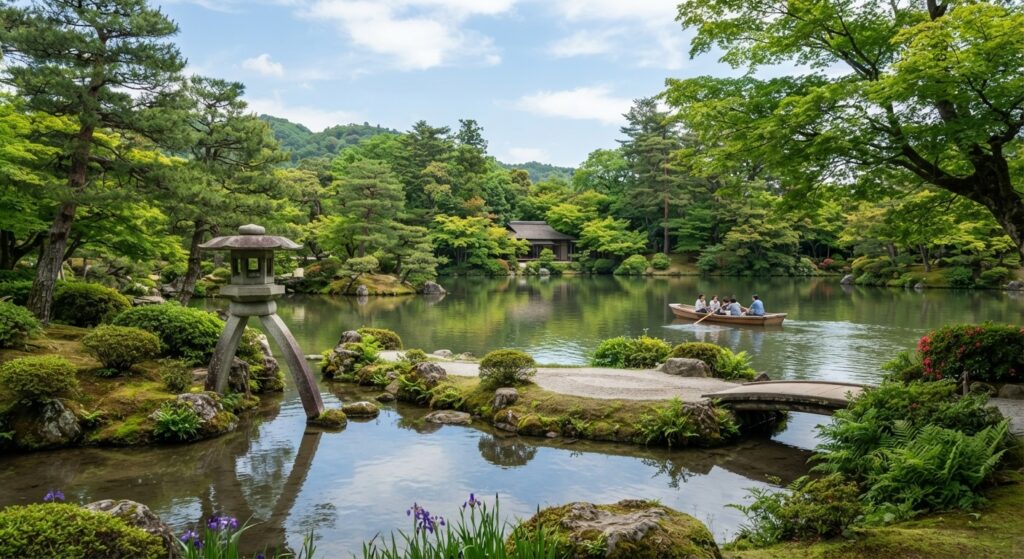
One of Japan’s three most celebrated gardens, Kenrokuen wasn’t built by a single ruler with a single vision — it was expanded and refined across multiple generations of Maeda lords, starting in the 1620s and developing over roughly 200 years. That multi-generational construction is part of what makes it worth knowing before you go: this is less a single grand statement and more a slow accumulation of taste, refined by people who never met each other but were working toward the same idea of what a perfect garden should be.
Time to budget: 1.5–2 hours, longer during cherry blossom or autumn foliage season.
Kanazawa Castle
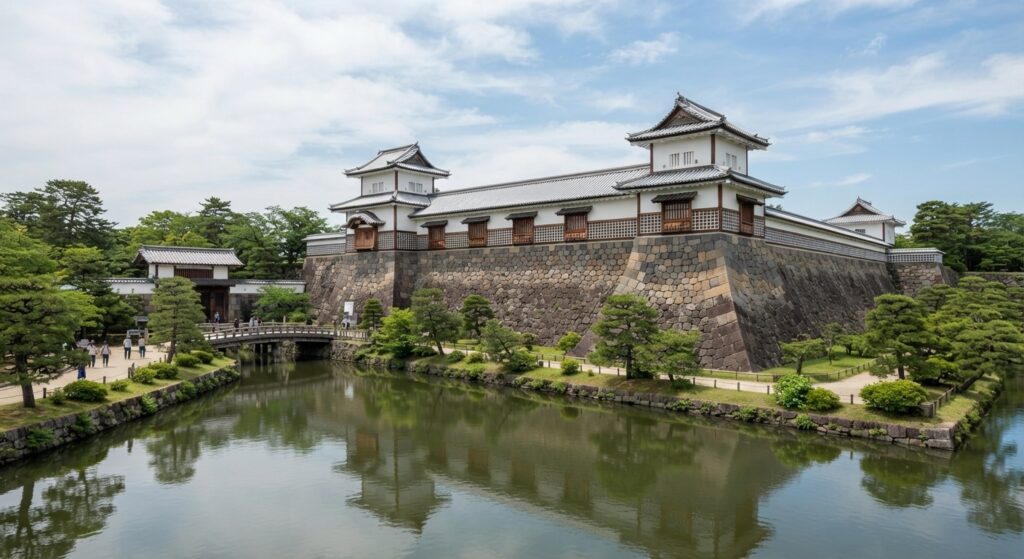
Sitting right next to Kenrokuen, Kanazawa Castle was the Maeda clan’s seat of power, established after Maeda Toshiie took control of the domain in 1583. Like many Japanese castles, it burned down repeatedly over the centuries — most of what stands today has been reconstructed using traditional techniques and materials, with major restoration work continuing into recent decades. That’s a useful contrast to point out if you’ve also visited Osaka Castle: Osaka’s tower was rebuilt in modern reinforced concrete, while Kanazawa’s reconstructions have leaned toward traditional wood-and-plaster building methods, giving it a noticeably different feel despite both being “rebuilt” castles.
Time to budget: 1–1.5 hours, easily combined with Kenrokuen next door.
Higashi Chaya District
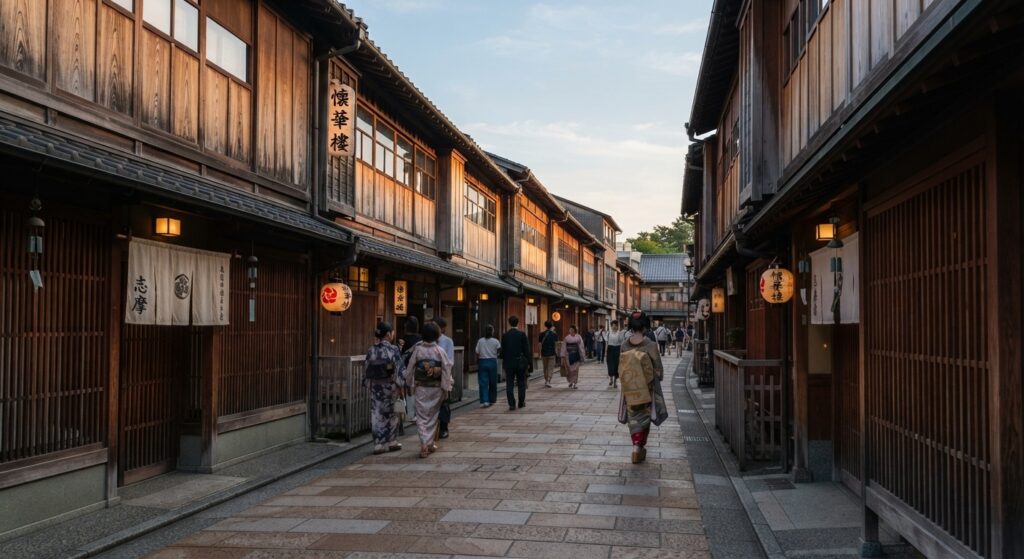
Established in 1820 as an officially sanctioned geisha entertainment district, Higashi Chaya’s wooden lattice-front teahouses are largely original Edo-period architecture — not a recreation. A small number of geisha (called geiko in the Kanazawa dialect) still work in the district today, which makes this one of the few places in Japan, alongside parts of Kyoto, where the tradition survives in any active form.
Time to budget: 1–1.5 hours, best in late afternoon light.
Nagamachi Samurai District
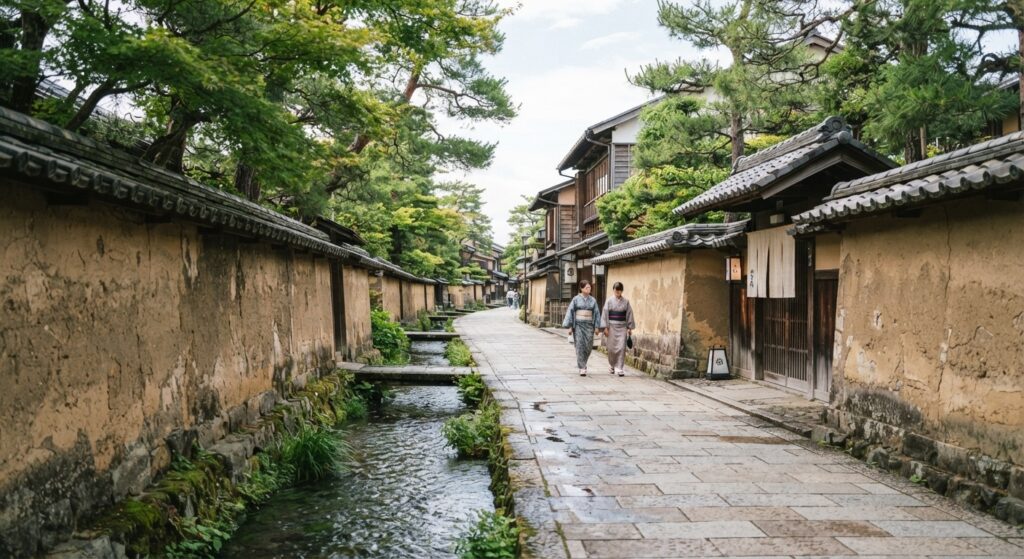
While Higashi Chaya shows you entertainment-class Edo Japan, Nagamachi shows you the mid-ranking samurai who administered the domain. Earthen walls, narrow lanes, and a preserved irrigation canal system are still intact here, and a couple of former samurai residences are open to the public. It’s a useful, concrete way to explain Edo-period class structure to visitors — the physical separation between samurai neighborhoods and merchant neighborhoods was a real, enforced boundary, not just a social one.
Time to budget: 1 hour.
Omicho Market
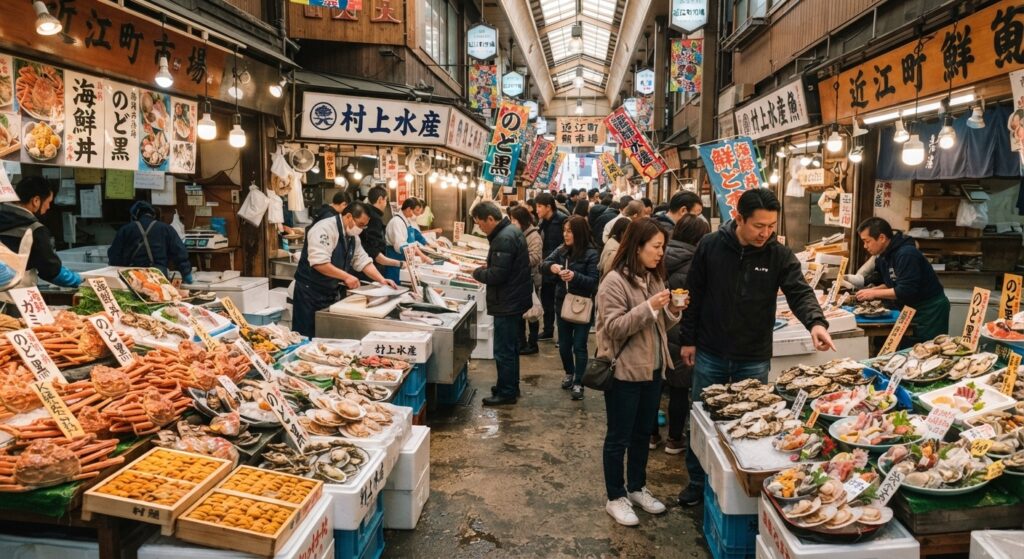
Operating since the Edo period, Omicho has been called “Kanazawa’s kitchen” for good reason — it’s still a working market, not a tourist recreation of one. Fresh seafood from the Sea of Japan and Kaga-grown vegetables are the draw, and it’s one of the best places in the city to eat well without a reservation.
Time to budget: 1–1.5 hours, best in the morning.
21st Century Museum of Contemporary Art
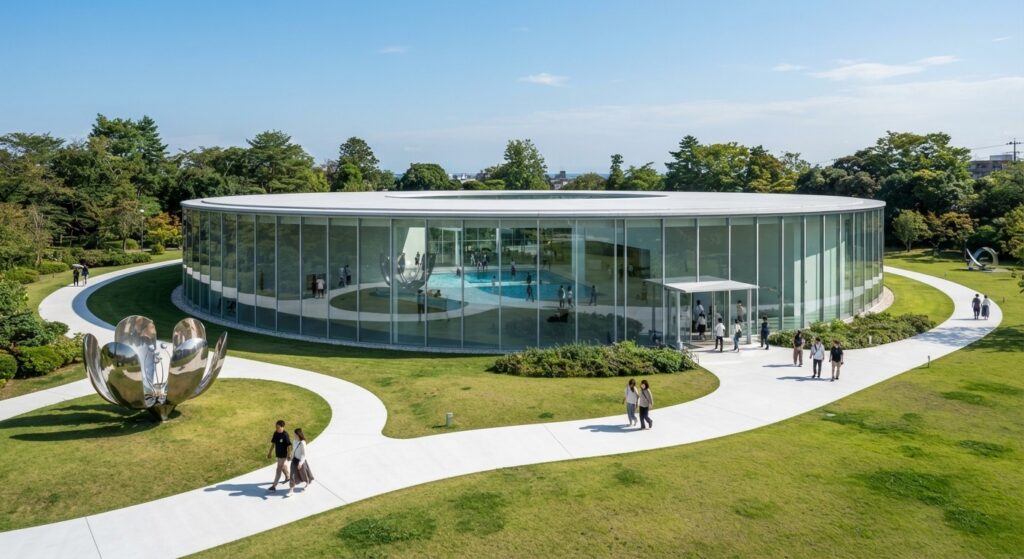
For a counterpoint to all the history, the 21st Century Museum (opened 2004) plays a similar role in Kanazawa that Umekita plays in Osaka — proof the city isn’t only about the past. Its circular, glass-walled design and rotating contemporary exhibits draw a very different crowd than the historic districts nearby, and it sits close enough to Kenrokuen to slot in easily.
Time to budget: 1–2 hours depending on current exhibitions.
Suggested Route by Traveler Type
| Area | Time Needed | Best For | Historical Hook |
|---|---|---|---|
| Kenrokuen Garden | 1.5–2 hrs | First-time visitors, garden/nature-focused travelers | Built across 200 years by generations of Maeda lords |
| Kanazawa Castle | 1–1.5 hrs | History-focused travelers, pairs naturally with Kenrokuen | 1583 founding, traditional-method reconstruction |
| Higashi Chaya | 1–1.5 hrs | Travelers who want original (not reconstructed) Edo architecture | 1820 sanctioned geisha district |
| Nagamachi | 1 hr | Travelers interested in social/class history | Preserved mid-rank samurai residences |
| Omicho Market | 1–1.5 hrs (morning) | Food-focused travelers | Edo-period market, still fully functional |
| 21st Century Museum | 1–2 hrs | Travelers wanting a modern counterpoint | 2004, contemporary art |
A comfortable one-and-a-half-day itinerary: day one covers Kenrokuen, Kanazawa Castle, and the 21st Century Museum (all within walking distance of each other), with Omicho for lunch; day two morning covers Higashi Chaya and Nagamachi before heading onward.
Local Culture and Etiquette
- Photographing geiko: If you’re lucky enough to spot a geiko in Higashi Chaya, treat it the same way you would in Kyoto’s Gion — no blocking their path, no photographing without at least a nod of acknowledgment, and never following them into private lanes or entrances. They’re working professionals commuting to appointments, not photo subjects.
- Private property in the historic districts: Many of the teahouses and samurai residences that look picturesque from outside are still private homes or working businesses. Stick to the streets and the specific buildings marked as open to visitors.
- Gold leaf experiences: Kanazawa’s gold leaf craft tradition has turned into a popular hands-on tourist activity (applying gold leaf to chopsticks, boxes, even ice cream). It’s touristy, but it’s rooted in a real and still-active local industry, so it’s a reasonable way to spend an hour without feeling like you’re doing something manufactured purely for visitors.
Noto Peninsula: A Region Still Rebuilding
Worth knowing before you go: on January 1, 2024, a major earthquake struck the Noto Peninsula, the finger of land extending north from the Kanazawa area. Kanazawa city itself came through with comparatively limited damage, but towns further out on the peninsula — Wajima, Suzu, and Nanao among them — were hit hard, and recovery is still very much in progress.
As of late 2026, that recovery is visible in both directions. Wakura Onsen, a hot spring town on the peninsula, has seen roughly half of its member ryokan reopen to guests, with ongoing work to restore the waterfront infrastructure the whole hot spring district depends on. At the same time, some areas — including Wajima’s historic morning market street, badly damaged by fire during the quake — are still in the rebuilding phase rather than open for visitors.
For travelers with extra time in their itinerary, a short extension from Kanazawa into the Noto region is one concrete way to support that recovery directly, through lodging and dining spend in areas that depend on tourism. It’s not necessary to enjoy Kanazawa itself, and this guide doesn’t cover Noto in detail — but it’s worth knowing the region exists just north of the city, at a different stage of its story.
FAQ
How many days do you need in Kanazawa?
One and a half to two days covers the core sights comfortably. It works well as a stop between Tokyo and Kyoto, or as a dedicated side trip from either city.
Is Kanazawa a day trip from Kyoto or Tokyo?
[Internal note: verify current shinkansen/train times before publishing — travel time claims need confirmation against current timetables.]
What’s the best season to visit Kenrokuen?
Cherry blossom season (early April) and autumn foliage (mid-to-late November) are the two peak windows, though both come with larger crowds than the rest of the year.
Can you actually see geiko in Higashi Chaya?
Occasionally, usually in the early evening as they move between appointments. It’s not guaranteed, and they should never be treated as a photo attraction — see the etiquette section above.
Is Kanazawa affected by the 2024 earthquake?
Kanazawa city itself was not significantly damaged and is fully open to visitors. The hardest-hit areas are further out on the Noto Peninsula, and recovery there is ongoing — see the section above for more detail.
comment