I typed “best tourist spots in Japan ranked by satisfaction” into Google before my first trip, expecting a clean top-10 list. What I got instead was a mess: five different sites, five different rankings, none citing a real source. One site had Kinkaku-ji at #1. Another had it at #7. A “satisfaction score” that changes that much between articles isn’t measuring satisfaction — it’s measuring which spots get the most clicks.
Here’s the thing nobody tells you: there is no official satisfaction ranking for tourist spots in Japan. Japan’s Tourism Agency tracks which prefectures visitors go to, not how much they enjoyed any single spot once they got there. Every “ranking” you find online is really just a popularity list dressed up with a different word.
So instead of chasing a number that doesn’t exist, we looked at something more honest: what people’s phones actually do once they arrive. Using a year of anonymized foot-traffic data (June 2025–May 2026) across five of Japan’s most-visited spots, we tracked how long people actually stayed and how many came back for a second visit. Because if a place is genuinely satisfying, people either linger — or they return. Both are things a “top 10” list can’t tell you, and both are things the data can.
Here’s what five spots’ worth of real visitor behavior reveals about which ones actually deliver.
- What five spots’ foot-traffic data actually shows
- Kiyomizudera: The One Worth Giving a Full Hour
- Fushimi Inari Taisha: Two Completely Different Visits, Same Address
- Nara Park: Satisfaction Depends on Whether You Budget an Hour
- Shinjuku Gyoen: Short Visits, High Return Rate
- Akihabara: Built to Be Revisited, Not Toured
- Pass-Through or Destination — Which Kind of “Good” Are You Looking For?
- FAQ
What five spots’ foot-traffic data actually shows
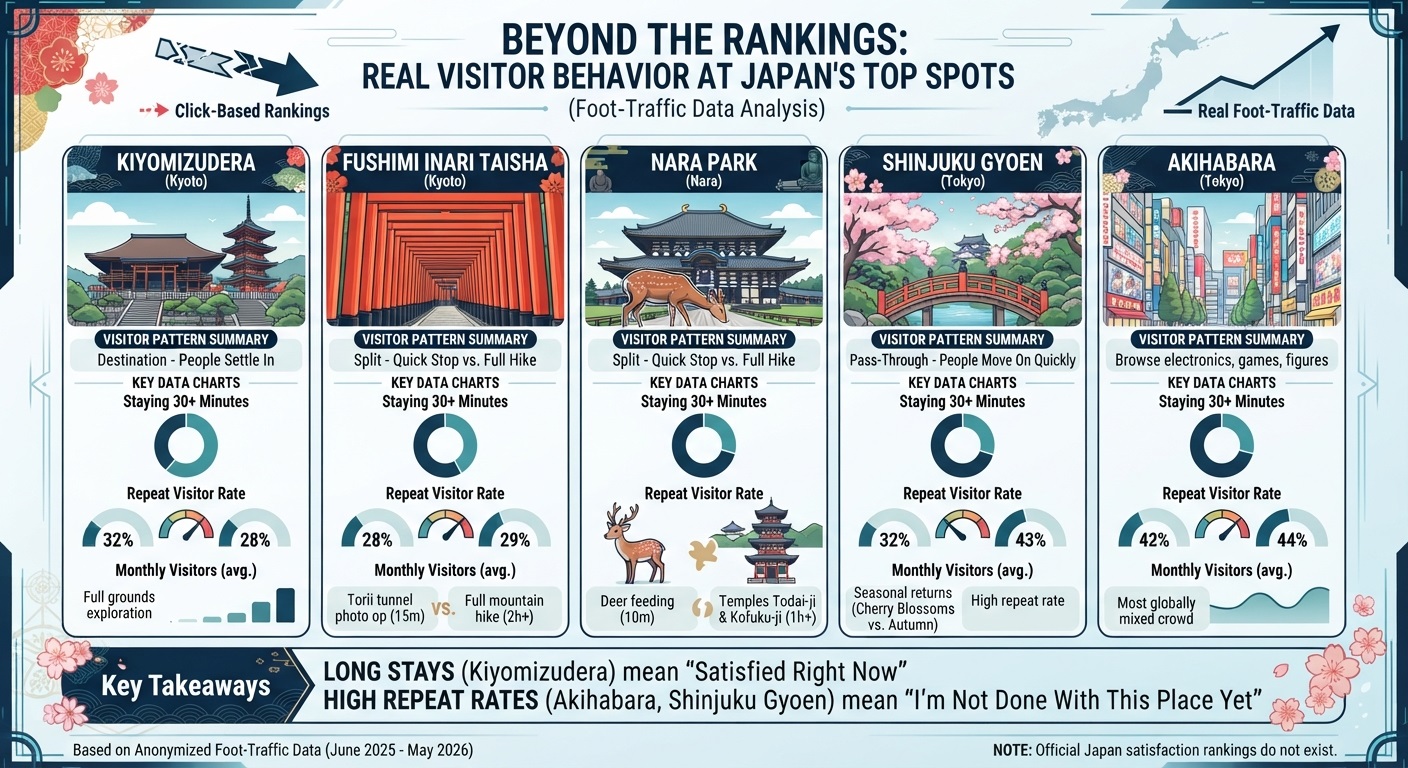
Before picking a “winner,” here’s the raw data from a year of anonymized visitor tracking (June 2025–May 2026) at five of Japan’s most-visited spots.
| Spot | Monthly Visitors (avg.) | Staying 30+ Minutes | Repeat Visitor Rate | Visitor Pattern |
|---|---|---|---|---|
| Kiyomizudera | ~270,000 | ~60% | 32% | Destination — people settle in |
| Fushimi Inari Taisha | ~600,000 | ~40%* | 28% | Split — quick photo stop or full hike |
| Nara Park | ~520,000 | Spread across all bands | 29% | Split — grounds too large for one pattern |
| Shinjuku Gyoen | ~1,310,000 | ~30%* | 43% | Pass-through — people move on quickly |
| Akihabara | ~1,670,000 | ~30%* | 44% | Pass-through — people move on quickly |
*Estimated from reported “under 15 minutes” share.
At first glance, this looks backwards. Akihabara and Shinjuku Gyoen — the two spots where people leave fastest — have the highest repeat visitor rates. Kiyomizudera, where people stay the longest, sits in the middle of the pack on repeat visits.
That’s not a contradiction. It’s two different kinds of satisfaction.
Long stays mean “this delivered, right now.” Kiyomizudera’s 60% figure means most visitors aren’t just snapping a photo from the veranda and leaving — they’re exploring the grounds, the shrine paths, the surrounding streets. That’s a spot built for a single, complete experience.
High repeat rates mean “I’m not done with this place yet.” Akihabara and Shinjuku Gyoen are the opposite: most visits are short, but 4 in 10 visitors have been there before. These aren’t one-and-done sights — they’re places people build into a longer trip, or come back to on a second or third visit to Japan, because there’s always something new to browse or a different season to see.
Fushimi Inari and Nara Park don’t fit either pattern cleanly, and that’s the most useful finding of all: both have wide grounds where visitor experience splits in two. At Fushimi Inari, roughly half the crowd snaps a photo at the first few torii gates and turns back, while the other half hikes the full mountain path — two completely different visits happening at the same address. Nara Park works the same way: feed the deer for ten minutes, or spend an hour moving between the deer, Todai-ji, and Kofuku-ji.
In other words — for these two spots, satisfaction isn’t fixed by the location. It’s decided by how much time you’re willing to give it.
Kiyomizudera: The One Worth Giving a Full Hour
Kiyomizudera’s numbers make sense the moment you stand on the wooden veranda: 6 in 10 visitors stay more than half an hour, the highest of any spot on this list. This isn’t a five-minute photo op — it’s a full walk through the grounds, down to Otowa Waterfall, and often out into the historic streets of Higashiyama that surround it.
The data also skews young: nearly 4 in 10 visitors are in their twenties, more than any other spot here. If you’re picturing a quiet, contemplative temple visit, adjust your expectations — this is a lively, photo-heavy crowd, especially in the late morning.
Satisfaction tip: the 30-minutes-plus crowd isn’t just touring the main hall. Budget time to walk down through Sannenzaka and Ninenzaka afterward — that’s where the “worth it” feeling tends to compound.
Fushimi Inari Taisha: Two Completely Different Visits, Same Address
Roughly 40% of visitors here stay 30 minutes or more — but that average hides a split. Some people walk through the first cluster of torii gates, take the classic tunnel photo, and leave in under fifteen minutes. Others keep climbing all the way up Mount Inari, a round trip that can take two hours or more.
Neither group is doing it “wrong” — but only one of them is getting the full experience the shrine is known for. Fushimi Inari also draws the most globally balanced crowd on this list, with no single nationality dominating, which tracks with its status as a near-universal “must-see” for first-time visitors (72% here are on their first trip to Japan).
Satisfaction tip: if you only have time for the first 10 minutes of torii gates, know that you’re seeing the version of Fushimi Inari everyone’s Instagram feed already shows you. The quieter, more rewarding version is a 30-45 minute walk further up.
Nara Park: Satisfaction Depends on Whether You Budget an Hour
Nara Park is the hardest spot on this list to summarize with one number, because its visitors genuinely split three ways: quick stops under 15 minutes, mid-length visits, and 30-plus-minute wanderers, in roughly even thirds. There’s no single “typical” Nara Park visit.
The deer are the draw — hand-feeding a bowing deer a rice cracker is the single most-repeated moment in every trip report — but the park’s real satisfaction ceiling is higher than that ten-minute encounter suggests. Todai-ji and Kofuku-ji sit within the same grounds, and visitors who budget time for both, not just the deer, are the ones giving the fullest account of the park.
Satisfaction tip: if Nara is a day trip from Kyoto or Osaka, resist the urge to treat it as a two-hour deer photo-op sandwiched between trains. The visitors getting the most out of it are staying long enough to see the temples too.
Shinjuku Gyoen: Short Visits, High Return Rate
Shinjuku Gyoen has the second-highest repeat visitor rate of any spot here — 43% — despite most people staying under 15 minutes per visit. That combination only makes sense once you factor in the seasons: this is a garden people return to specifically because it looks different in April than it does in November.
It also draws the most Western visitors of the five spots, with the U.S. as the second-most-common nationality — a contrast to the Korea- and Taiwan-heavy crowds elsewhere on this list. For a garden inside central Tokyo, that’s a notably international, repeat-driven audience.
Satisfaction tip: a single quick walk-through during cherry blossom season is the version most first-timers get. If you’ve already done that, a quieter autumn visit is a genuinely different experience, not a repeat of the same one.
Akihabara: Built to Be Revisited, Not Toured
Akihabara has the highest repeat visitor rate on this list at 44%, and the shortest typical visit. That’s not a contradiction — it’s the nature of the place. Nobody “finishes” Akihabara in one pass. It rewards people who treat it as a recurring stop rather than a single afternoon: one visit for electronics, another for retro games, another for figures.
The crowd here is also the most evenly split between first-timers and repeat visitors of any spot on this list (56%/44%), and draws from more than 20 countries with no single nationality dominating — a genuinely global, genuinely mixed audience.
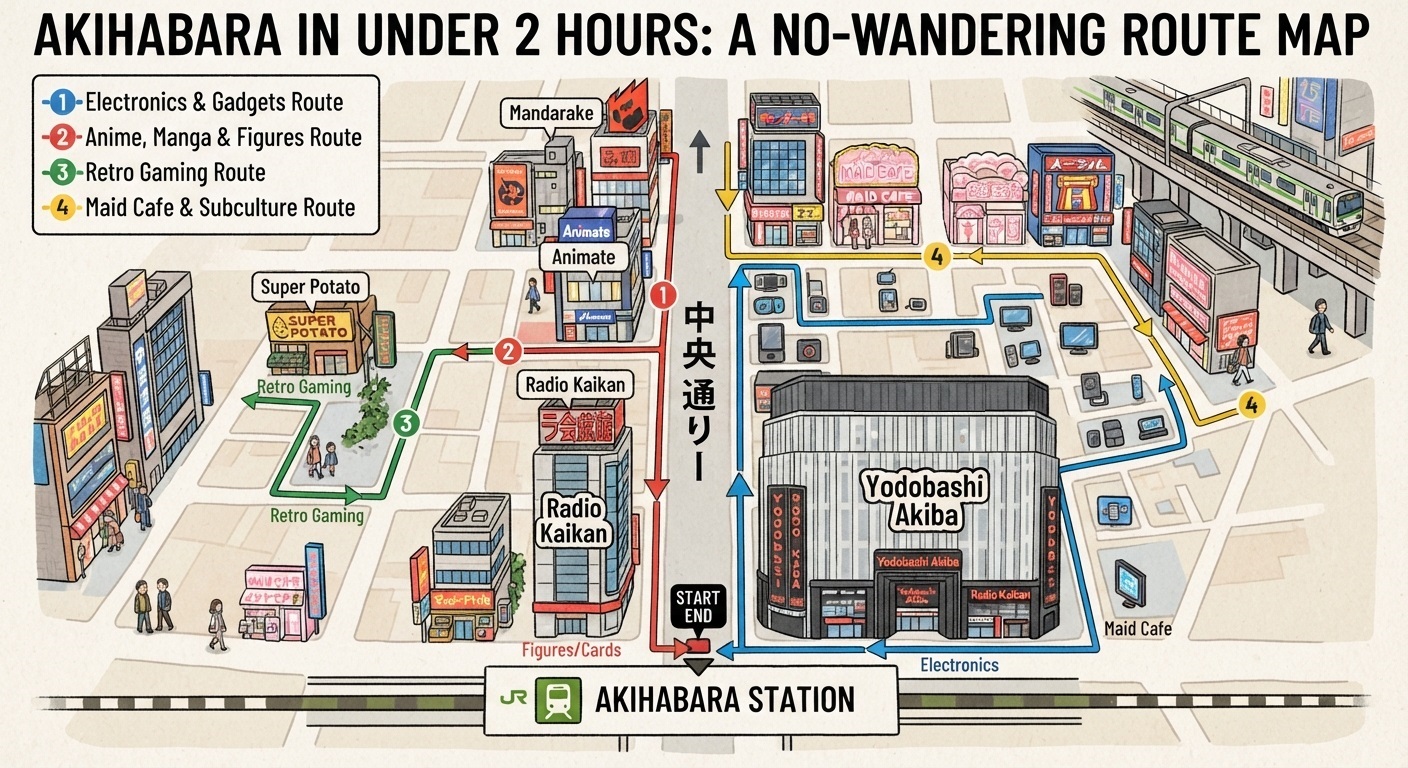
Satisfaction tip: if you’re trying to “do” Akihabara in one two-hour block, you’re working against how the district is actually used. A more satisfying approach: pick one interest (retro gaming, figures, electronics) and go deep on that, rather than skimming everything.
(For a full route-by-route breakdown of Akihabara by interest type, see our [Akihabara guide].)
Pass-Through or Destination — Which Kind of “Good” Are You Looking For?
Line these five spots up and a pattern falls out: they’re not on a single spectrum from “bad” to “good.” They’re answering two different questions.
Destination spots (Kiyomizudera) ask: does this one visit feel complete? You show up once, you stay a while, you leave satisfied. There’s no strong pull to come back on the same trip.
Pass-through spots (Akihabara, Shinjuku Gyoen) ask: do I want this in my life again? A single visit is short and maybe even feels incomplete — and that’s precisely what pulls people back, whether that’s later in the same trip or on a future one.
Split spots (Fushimi Inari, Nara Park) put the question back on you. The data shows two visitor populations at the same address, and which one you end up in is a function of how much time you’re willing to give the place — not the place itself.
None of these patterns is objectively “more satisfying.” A traveler with one day in Kyoto who wants a single, complete, unhurried experience should weight Kiyomizudera-style spots highly. A traveler on their third trip to Japan, looking for a place that rewards familiarity, should weight Akihabara-style spots highly. The most useful question isn’t “which spot has the best rating” — it’s “which kind of satisfaction am I actually looking for on this trip?”
FAQ
Is there an official satisfaction ranking for tourist spots in Japan?
No. Japan’s Tourism Agency publishes prefecture-level visitor data, not spot-by-spot satisfaction scores. Any “ranking” you see online is based on private data (review platforms, foot-traffic analytics, or simple visitor counts) rather than an official measure of satisfaction.
Does a longer visit always mean a better experience?
Not necessarily — it depends what you’re looking for. Longer stays tend to mean a single visit felt complete (like Kiyomizudera). Shorter visits with high repeat rates (like Akihabara or Shinjuku Gyoen) suggest the opposite kind of satisfaction: a place people keep coming back to rather than one they need to linger in.
Are these five spots the “best” in Japan?
They’re five of the most-visited spots with enough foot-traffic data to compare meaningfully — not a claim that they’re objectively the best. The point of this piece is the method (using visitor behavior instead of guesswork), which can be applied to any spot with similar data.
How much time should I budget for Fushimi Inari or Nara Park?
For Fushimi Inari, 15 minutes covers the main torii tunnel; a full round trip up Mount Inari runs 2+ hours. For Nara Park, budget at least an hour if you want to see the temples in addition to the deer — a quick deer visit alone can be done in 10-15 minutes.

comment