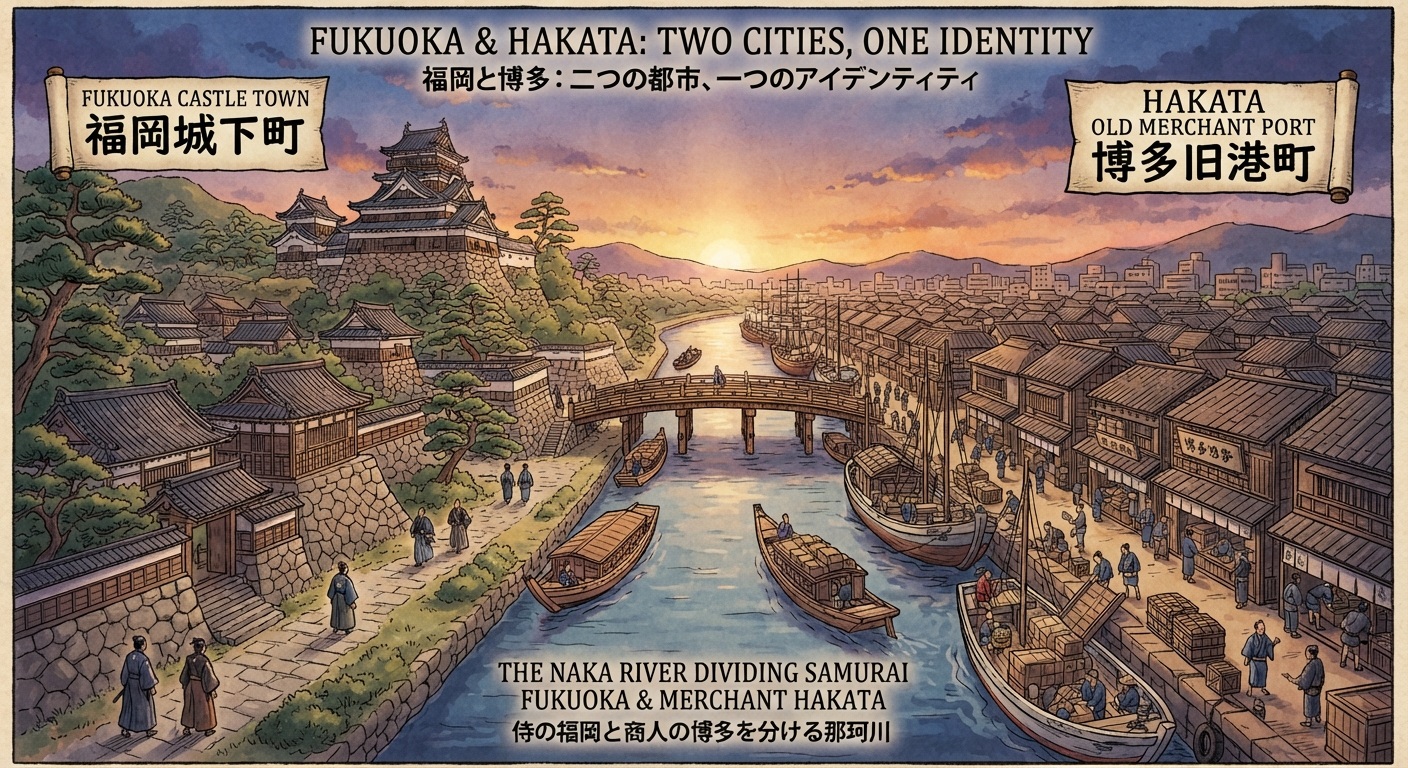
Fly into Fukuoka Airport and the signs say Fukuoka. Get off at the city’s main train station and the signs say Hakata. That’s not a translation quirk ? it’s the leftover scar tissue of a 19th-century argument that the city never fully resolved, and it’s one of the more interesting entry points into understanding how this city works.
Fukuoka has also become one of the fastest-growing names on the inbound tourism map, largely because of something most visitors don’t think about until they’re already there: it’s genuinely closer to Seoul than it is to Tokyo. That proximity has made it the entry point of choice for a huge share of Korean travelers, and it’s increasingly showing up on itineraries for travelers from further afield who want a Kyushu base that isn’t just a day trip from Kansai.
One River, Two Cities
For most of its history, what’s now central Fukuoka was actually two separate towns facing each other across the Naka River. On the west bank sat Fukuoka, a samurai castle town built around the Kuroda clan’s stronghold. On the east bank sat Hakata, a much older merchant port city that had been trading with the Asian continent for centuries before the castle even existed. Different classes, different economies, different identities ? just a river apart.
When Japan modernized its city systems in 1889, the two towns were forced to merge into a single municipality, and someone had to decide what to call it. The city council vote reportedly ended in a tie, and the tie-breaking vote went to a council chairman from the Fukuoka side ? so “Fukuoka” won. As a partial concession to the Hakata side, when the new train station opened the following year, it was named Hakata Station rather than Fukuoka Station. That split identity has stuck around for over 130 years, which is why you’ll still hear locals casually use “Hakata” to describe food, dialect, and festival culture that’s specifically tied to the old merchant side of the river, even though the whole city is officially “Fukuoka.”
Major Sights and the History Behind Them
Fukuoka Castle Ruins (Maizuru Park)
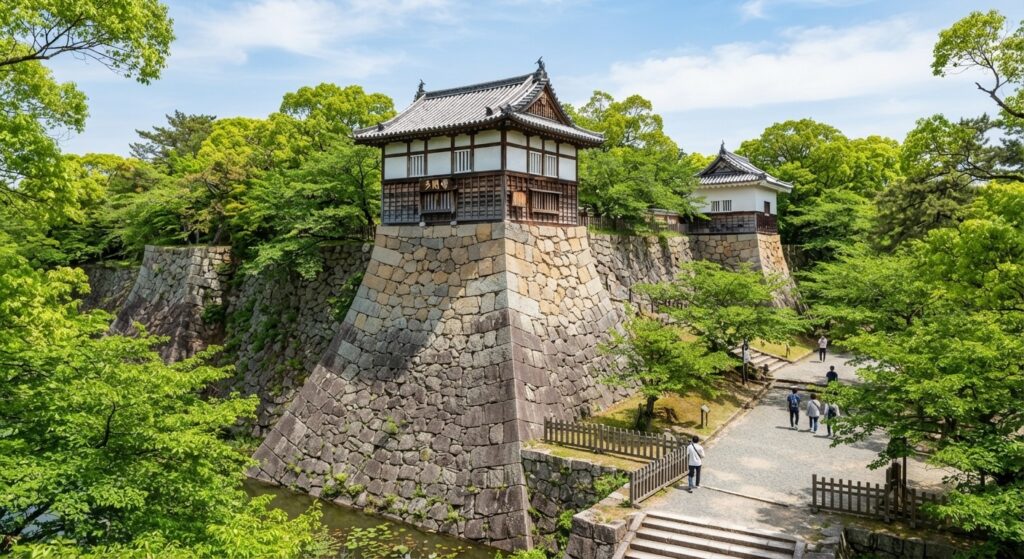
Built starting in 1601 by Kuroda Nagamasa after his family was rewarded with the domain following the Battle of Sekigahara, Fukuoka Castle took seven years to complete and was, at the time, one of the largest castle complexes in Kyushu. Unlike Osaka or Kanazawa, there’s no rebuilt tower here ? the castle was torn down during the Meiji-era abolition of feudal domains, and today you walk through stone foundations, surviving turrets, and open parkland rather than a reconstructed main keep. For travelers who’ve already seen a rebuilt castle elsewhere in Japan, this is a useful contrast: a chance to see the bones of a castle without the modern overlay.
Time to budget: 1?1.5 hours, easily paired with neighboring Ohori Park.
Dazaifu Tenmangu
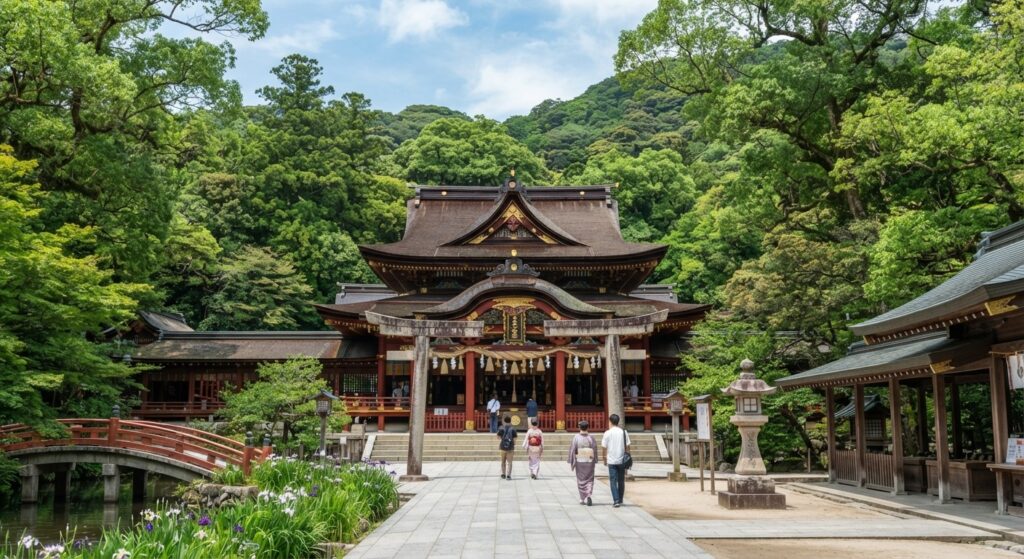
This is arguably the most historically significant site in the entire region, and it predates Fukuoka Castle by nearly 700 years. Dazaifu was established in the 7th century as the Japanese imperial government’s administrative outpost for all of Kyushu, responsible for defense and diplomacy with China and Korea ? effectively the government’s front door to the Asian continent for centuries. The shrine itself was built in 905 CE on the grave of Sugawara no Michizane, a scholar-official who was exiled to Dazaifu and later deified as the god of learning. It’s now one of the most visited shrines in Japan for students praying before exams, and the broader Dazaifu area still carries the weight of having once been Kyushu’s de facto capital.
Time to budget: 2?2.5 hours including travel from central Fukuoka (it’s a short train ride out of the city center).
Genko Borui (Mongol Invasion Wall)
Less famous but genuinely unusual: scattered remnants of a stone wall built along Hakata Bay after the first Mongol invasion of Japan in 1274, constructed specifically to block a second invasion fleet from landing. That second invasion came in 1281 and was repelled, with a typhoon that struck the Mongol fleet later mythologized as the original “kamikaze” (divine wind). Surviving wall sections can still be seen at a few spots along the bay, including near Nokonoshima and Imazu ? a rare physical trace of one of the most consequential near-misses in Japanese history.
Time to budget: 30?45 minutes if visiting a wall section specifically, often combined with a Nokonoshima Island trip.
Canal City Hakata
For a hard pivot to the present, Canal City is a 1996 shopping and entertainment complex built around an artificial canal running through the middle of the building ? a deliberately modern counterpoint to the historic sites elsewhere in the city. It’s not a must-see in the way Dazaifu is, but it’s a useful one- or two-hour stop that shows the other half of what Fukuoka is now: a genuinely modern, fast-growing commercial hub, not just a historical curiosity.
Time to budget: 1?2 hours.
Ohori Park
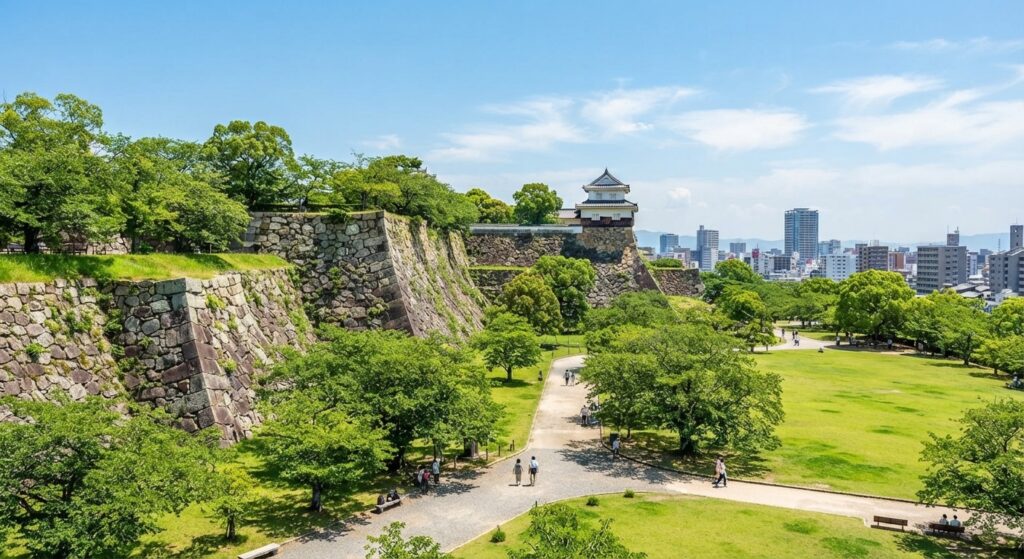
Built on the former outer moat of Fukuoka Castle and redesigned in the 1920s with a large central pond modeled loosely on West Lake in Hangzhou, Ohori Park is where the castle’s military infrastructure quietly turned into civic green space. It’s a good example of how much of central Fukuoka’s layout is still, structurally, the old castle town ? even where the castle itself is gone.
Time to budget: 45 minutes?1 hour, easily combined with the castle ruins.
Suggested Route by Traveler Type
| Area | Time Needed | Best For | Historical Hook |
|---|---|---|---|
| Fukuoka Castle Ruins / Ohori Park | 1.5?2.5 hrs combined | History-focused travelers who want an unrebuilt castle | 1601 founding, Meiji-era demolition |
| Dazaifu Tenmangu | 2?2.5 hrs (half-day with travel) | Travelers wanting the region’s deepest history | 7th-century administrative capital, 905 CE shrine |
| Genko Borui | 30?45 min | History travelers with extra time, Nokonoshima day-trippers | 1274/1281 Mongol invasions |
| Canal City Hakata | 1?2 hrs | Shopping, evening entertainment, families | 1996, modern Fukuoka |
A comfortable two-day plan: day one in central Fukuoka covering the castle ruins, Ohori Park, and Canal City in the evening; day two dedicated largely to a Dazaifu half-day trip, with the afternoon free for yatai food stalls back in the city.
Local Culture and Etiquette
- Yatai (street food stalls): Fukuoka’s open-air food stalls, clustered especially around Nakasu and Tenjin, are one of the city’s defining food experiences and operate differently from a regular restaurant ? seating is tight, turnover is expected, and lingering too long after you’ve finished eating is mildly discouraged during busy hours. Cash is still common at many stalls, so it’s worth carrying some.
- Hakata vs. Fukuoka in conversation: Locals use both names somewhat interchangeably depending on context (festivals, food, and dialect tend to get the “Hakata” label; official and administrative references use “Fukuoka”). Don’t worry about getting it wrong ? even locals aren’t fully consistent about it.
- Dazaifu as a working shrine: Remember this is an active site of worship, especially popular with students around exam season. Keep noise down near the main hall and follow standard shrine etiquette (bow before the gate, don’t walk through the center of the torii path, which is traditionally reserved for the deity).
FAQ
How many days do you need in Fukuoka?
Two to three days covers the city center and a Dazaifu day trip comfortably. It also works well as a short add-on to a Kyushu itinerary that includes Nagasaki or Kumamoto.
Why does the airport say Fukuoka but the train station says Hakata?
They’re leftovers from the 1889 merger of two separate towns ? Fukuoka (the old samurai side) and Hakata (the old merchant side) ? that never fully agreed on which name should represent the unified city. See the history section above.
Is Fukuoka worth visiting if I’ve already done Kyoto and Osaka?
Yes, particularly for food culture and as a gateway to the rest of Kyushu ? it offers a genuinely different regional identity (closer historically and geographically to Korea than to Kansai) rather than more of the same.
How far is Fukuoka from Seoul?
[Internal note: verify current flight/ferry times before publishing ? “closer to Seoul than Tokyo” claim is directionally accurate but exact travel times should be confirmed against current schedules.]
What food is Fukuoka specifically known for?
Tonkotsu ramen originates here, along with mentaiko (spicy marinated pollock roe) and motsunabe (offal hot pot) ? all heavily represented in the yatai stalls.
comment