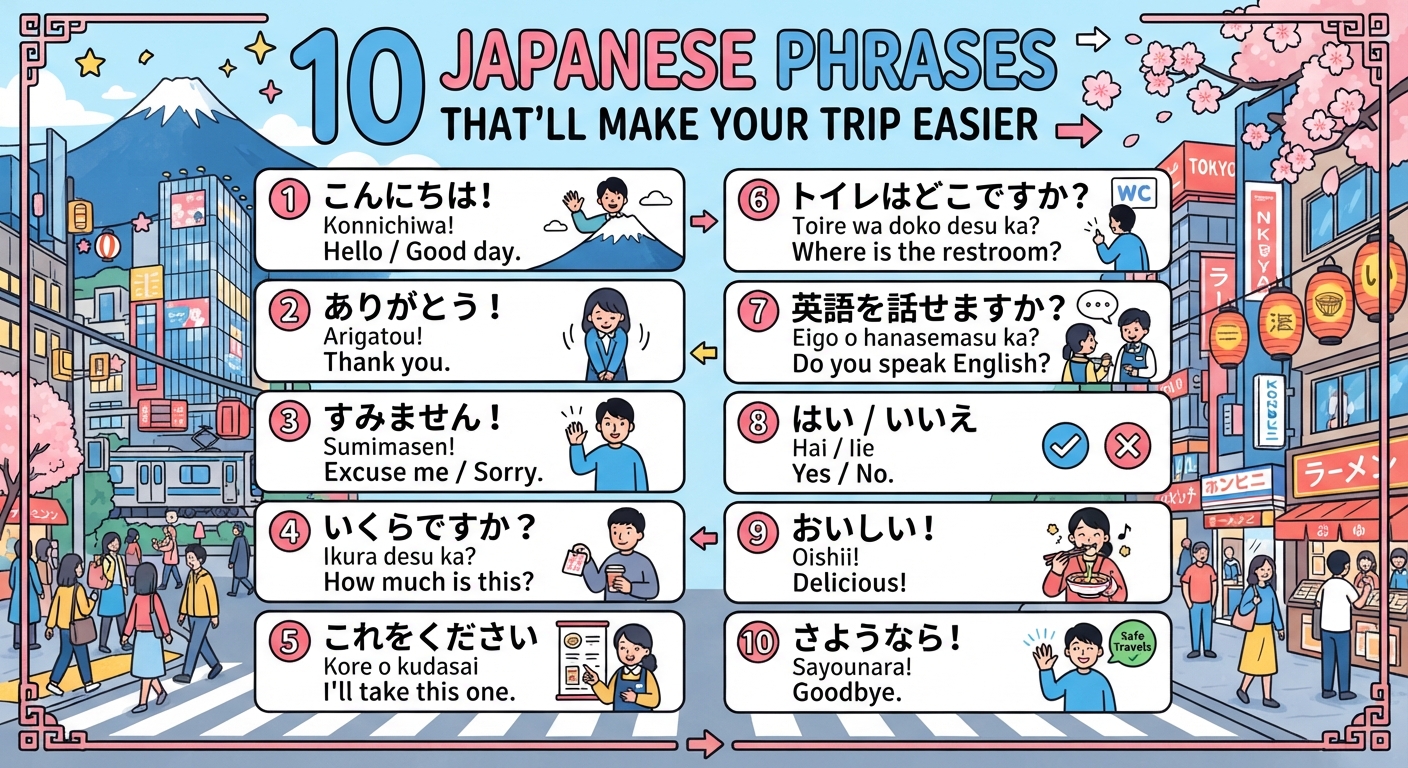
A friend of mine spent a solid four minutes standing at a ramen shop counter in Osaka, phone out, Google Translate app open, trying to ask if he could pay by card. The chef waited. The line behind him grew. By the time the translation loaded, he’d already fumbled his wallet onto the floor twice. He got his answer eventually — cash only — but the whole thing could’ve taken about three seconds if he’d known a single sentence.
That’s the thing about language barriers in Japan: they’re rarely as big as they feel in the moment. You don’t need to be fluent in Japanese to travel here. You really don’t. But there’s a huge difference between wandering around pointing at things and having a small handful of phrases that just… work, in almost any situation.
These are the ones I actually catch myself using on repeat — at convenience stores, restaurants, train stations, wherever. None of them require grammar knowledge. You just need to remember the sound and when to use it, and that’s it, you’re already ahead of 90% of visitors.
- 1. Sumimasen (すみません)
- 2. Arigatou (ありがとう)
- 3. Onegaishimasu (お願いします)
- 4. Daijoubu desu (大丈夫です)
- 5. Kore kudasai (これください)
- 6. ●● wa doko desu ka? (●●はどこですか?)
- 7. Kurejitto kaado wa tsukaemasu ka? (クレジットカードは使えますか?)
- 8. Ikura desu ka? (いくらですか?)
- 9. Wakarimasen / Wakarimashita (わかりません / わかりました)
- 10. Okaikei onegaishimasu (お会計お願いします)
- A quick note on how these actually get used
- FAQ
1. Sumimasen (すみません)
Say it like: soo-mee-mah-sen
This is the single most useful word in the Japanese language for a traveler, full stop. It means “excuse me,” but it also means “sorry,” and it also means a soft, quiet “thank you” in certain moments. Use it to get a staff member’s attention at a restaurant, to squeeze past someone on a crowded train, or to apologize for a small bump. If you only learn one word before your trip, make it this one.
2. Arigatou (ありがとう)
Say it like: ah-ree-gah-toh
“Thank you.” Simple, but it lands differently coming from a visitor who bothered to learn it. You’ll hear the more formal version, arigatou gozaimasu, from staff constantly — you don’t need to match that level of politeness as a tourist, but tacking on a little bow while you say it goes a long way.
3. Onegaishimasu (お願いします)
Say it like: oh-neh-gai-shee-mahs
Roughly “please,” but it’s doing more work than that translation suggests — it’s the all-purpose way to request something. Point at a menu item and say this, and you’ve just ordered. Hand over your passport at a hotel check-in with this, and you’ve made a polite request. It’s the verbal equivalent of a universal adapter plug.
4. Daijoubu desu (大丈夫です)
Say it like: dai-joh-boo dess
This one has a split personality, which is exactly what makes it so handy. It can mean “I’m okay / that’s fine” (accepting something), or it can mean “no thanks, I’m good” (politely declining). Context and tone do the work — a shopkeeper offers you a bag, you don’t need one, daijoubu desu with a small head shake does the job. Someone asks if you’re okay after you trip on a step, same phrase, different job.
5. Kore kudasai (これください)
Say it like: koh-reh koo-dah-sai
“This, please.” Point at literally anything — a dish on a plastic food display, an item behind a glass case, a button on a vending machine you’re unsure about — and say this. It’s the phrase that turns any language barrier into a non-issue, because you’re doing the communicating with your finger, not your vocabulary.
6. ●● wa doko desu ka? (●●はどこですか?)
Say it like: (word) wah doh-koh dess kah
“Where is ●●?” This is a template, not a fixed phrase — drop in whatever word you need. Toire (トイレ) for bathroom, eki (駅) for station, konbini (コンビニ) for convenience store. You don’t need to know a single other word of Japanese for this to work; just the noun and this frame around it. It’s the most flexible tool on this list.
7. Kurejitto kaado wa tsukaemasu ka? (クレジットカードは使えますか?)
Say it like: koo-reh-jee-toh kah-doh wah tsoo-kah-eh-mahs kah
“Can I use a credit card?” This one earns its spot on the list purely for practicality — Japan still runs more on cash than most visitors expect, especially at smaller restaurants, older shops, and some shrines or temples selling charms and stamps. Asking this before you order saves you the awkward moment of realizing you can’t pay after the fact. If the answer’s no, most places will point you to the nearest ATM or tell you cash only, sometimes with an apologetic bow.
8. Ikura desu ka? (いくらですか?)
Say it like: ee-koo-rah dess kah
“How much is this?” Handy anywhere a price isn’t clearly marked — flea markets, small family-run shops, that one stall at a festival with no visible tag. Most places in Japan display prices clearly, so you won’t need this constantly, but when you do need it, it’s the fastest way to get a straight answer.
9. Wakarimasen / Wakarimashita (わかりません / わかりました)
Say it like: wah-kah-ree-mah-sen / wah-kah-ree-mah-shta
Two sides of the same coin. Wakarimasen means “I don’t understand” — useful when someone’s speaking quickly and you need to signal that gently, rather than just nodding along and hoping for the best (which, honestly, leads to more confusion down the line). Wakarimashita means “I understood” — good for confirming instructions, like a staff member explaining how to use a ticket machine or where to line up.
10. Okaikei onegaishimasu (お会計お願いします)
Say it like: oh-kai-kay oh-neh-gai-shee-mahs
“Check, please.” At most restaurants you’ll need to signal this yourself — table service that brings the bill without asking isn’t really the norm here, and at many casual spots you actually pay at the register on your way out rather than at the table. This phrase is your cue to catch a staff member’s eye and wrap things up.
A quick note on how these actually get used
None of these phrases need to be perfect. Japanese speakers are generally very forgiving of a visitor’s pronunciation, and the effort itself tends to soften any interaction, even a purely transactional one like a convenience store checkout. Pair any of these with a slight nod or bow and you’ll rarely feel like you’re floundering, even if the grammar in your head is nowhere close to right.
If you want to go a level deeper, most of these also work as building blocks — sumimasen plus a place name, kore plus kudasai, that kind of thing. You don’t need to memorize sentences. You need to memorize a handful of tools and get comfortable mixing and matching them on the fly.
FAQ
Do I really need to learn any Japanese to visit Japan? No — English signage is common in big cities and major train stations, and plenty of people in the service industry know at least basic English. But a few phrases smooth over the small, everyday moments (ordering, paying, asking where something is) that don’t always come with an English option, especially outside the biggest tourist areas.
Will people understand me if my pronunciation is bad? Almost always, yes. Japanese pronunciation is fairly consistent and forgiving compared to some other languages — vowel sounds don’t shift around much, so even a rough attempt usually lands. Pointing at what you mean while you say the phrase also helps close any gap.
Is it rude to speak English instead of trying Japanese? Not rude, no — plenty of visitors get by entirely in English, especially in Tokyo, Osaka, and Kyoto. But making a small effort in Japanese, even just sumimasen and arigatou, tends to get a warmer response and can smooth things along in smaller, less touristy spots.
What’s the single most useful phrase on this list? Sumimasen. It covers “excuse me,” “sorry,” and a soft “thank you,” which means it works in more situations than anything else here — getting someone’s attention, apologizing for a bump, or wrapping up a small interaction.
Should I use a translation app instead of memorizing phrases? Apps are a great backup for anything complicated, but for the everyday stuff — ordering, paying, asking where the bathroom is — a memorized phrase is faster than pulling out your phone, waiting for a translation, and reading it aloud. Keep the app for emergencies or longer conversations; use these phrases for everything else.
However far your Japanese gets you, the effort itself tends to matter more than the accuracy — and worst case, a point, a smile, and a sumimasen will carry you through almost anything.
Planning your trip around Japan’s biggest tourist spots? Our guide on when to visit popular attractions to avoid the crowds pairs well with this one — knowing what to say helps, but knowing when to show up helps just as much.
comment