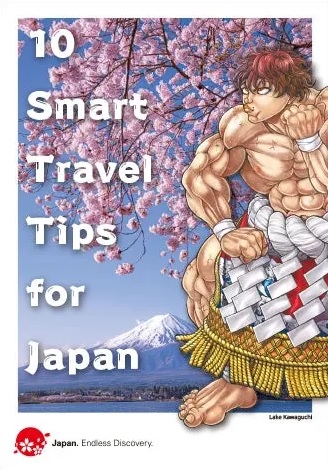
If you’d told me a decade ago that the guy who wrestles bears and punches through concrete pillars would one day be your etiquette coach for visiting Japan, I wouldn’t have believed you. But here we are: in September 2026, the Japan National Tourism Organization (JNTO) teamed up with Akita Shoten — the publisher behind the Baki manga franchise — to release an official travel tips booklet starring the series’ cast.
It’s a strange pairing on paper. Baki is a decades-long saga about underground fighting tournaments, monstrous strongmen, and a protagonist trying to become strong enough to beat his own father. It is not, historically, a franchise associated with polite train etiquette. And yet that’s exactly the joke JNTO is leaning into — using instantly recognizable, larger-than-life characters to get practical travel advice to actually stick with visitors who might otherwise skim past another generic “dos and don’ts” pamphlet.
Having read through what’s been published about the collaboration, here’s what’s actually in it — and, more usefully, the real logistics behind each tip for anyone planning a trip to Japan right now.
What the collaboration actually is
The booklet, titled “10 Smart Travel Tips for Japan,” was developed using feedback gathered from JNTO’s 26 overseas offices around the world — essentially a crowdsourced list of the questions and mistakes those offices hear from travelers most often. Akita Shoten’s Baki characters illustrate each tip, turning a normally dry information sheet into something people might actually stop and read.
A few practical details worth knowing:
- Languages: English, Korean, French, and Spanish (no Japanese version, since it’s aimed at inbound visitors).
- Formats: A pocket-sized printed booklet plus posters and stickers, alongside a digital PDF version hosted on JNTO’s site.
- Distribution: Physical copies at major Japanese airports and at travel expos/events overseas; the digital version is meant to be shareable ahead of a trip.
- Length: A tight 14 pages — this is meant to be skimmed in a few minutes, not studied.
Why does a manga publisher partner with a national tourism board? It’s a low-cost way for JNTO to get travel etiquette content noticed by an audience — long-running fandoms, particularly overseas — who might never click on an official government PDF otherwise. Baki has been running since 1991, has sold over 100 million copies, and has had multiple Netflix anime adaptations, so the built-in audience is real.
The 10 tips, and what they actually mean for your trip
The booklet’s topics are common-sense basics, but each one maps to a genuinely useful travel decision. Here’s the practical version of each:
1. Hands-free travel (luggage forwarding). Rather than dragging suitcases through train stations, same-day courier services (Yamato Transport’s “TA-Q-BIN” is the most common) will pick up your bags from your hotel or the airport and deliver them to your next hotel — usually for somewhere around ¥2,000–3,000 per large bag. Coin lockers at major stations are the other option for short-term storage, though during peak season the larger sizes can be hard to find by mid-morning.
2. Visiting regions beyond the big cities. A gentle nudge that Japan is not just Tokyo, Kyoto, and Osaka. If you have the time, a day trip or overnight stay in a smaller city or rural area tends to be both less crowded and more memorable than cramming another hour into an already packed capital-city itinerary.
3. IC card basics. Suica, Pasmo, and similar rechargeable cards work across nearly all trains, subways, and buses nationwide (with a handful of regional exceptions), and can usually be added to Apple Wallet or Google Wallet before you even land, skipping the ticket machine line entirely.
4. General public transit etiquette. Keep calls to a minimum, don’t eat on commuter trains (long-distance Shinkansen is more relaxed), and line up on the marked spots on the platform rather than clustering around the doors.
5. Carrying your own trash. Public trash cans are genuinely rare in Japan outside train stations and convenience stores. The standard local habit — and the one JNTO is asking visitors to adopt — is carrying a small bag for your own trash until you find a bin, rather than leaving it behind.
6. Using licensed taxis. Licensed taxis in Japan are metered, regulated, and consistently safe; the booklet’s point is mainly to steer travelers away from unlicensed drivers touting for business outside train stations and nightlife areas, which is more of an issue in a few nightlife districts than a nationwide problem.
7–8. Shrine and temple manners. The core points: a small bow before passing through a torii gate, quiet voices on the grounds, and following the posted photography rules — some inner halls and specific statues are off-limits to cameras even when the rest of the grounds are fair game.
9. Onsen (hot spring) etiquette. Wash and rinse thoroughly at the shower stations before entering the shared bath, keep your towel out of the water, and check the sign at the entrance for tattoo policies — a real sticking point for some visitors, since a portion of traditional onsen still restrict or ask guests to cover tattoos, though this is loosening in tourist-heavy areas.
10. Emergency information. The booklet closes with the Japan Visitor Hotline, a 24/7 multilingual call center for travelers dealing with anything from a medical situation to a lost passport.
Why this actually works as travel advice
None of these tips are new — most appear in some form across JNTO’s existing English-language guidance. What’s different is the delivery. A pocket booklet with familiar characters is far more likely to actually get opened and read at an airport gate than a generic laminated flyer, and that’s the entire point of the collaboration: reach, not novelty.
If you’re planning a first trip to Japan, the trash-bag habit and the IC card setup are the two that trip up visitors most often in practice — both are five-minute fixes that make the rest of the trip noticeably smoother.
FAQ
Where can I get the actual booklet?
Physical copies are being distributed at major airports in Japan and at overseas travel events; a digital PDF version is also being published on JNTO’s official website in all four languages.
Do I need to be a Baki fan to find this useful?
Not at all — the manga characters are just the delivery mechanism. The underlying tips apply to any first-time (or fifth-time) visitor to Japan.
Is this the same as JNTO’s general travel etiquette guidance?
Largely yes — it covers the same core points JNTO has published elsewhere, just condensed into a shorter, more visual format aimed at travelers who might not read a full guide.
Does the tattoo policy at onsen apply everywhere?
No — policies vary by facility. Many hotel and resort onsen in tourist areas now welcome visible tattoos or offer cover-up stickers, but it’s still worth checking a specific onsen’s policy before you go, especially at smaller, traditional bathhouses.
comment