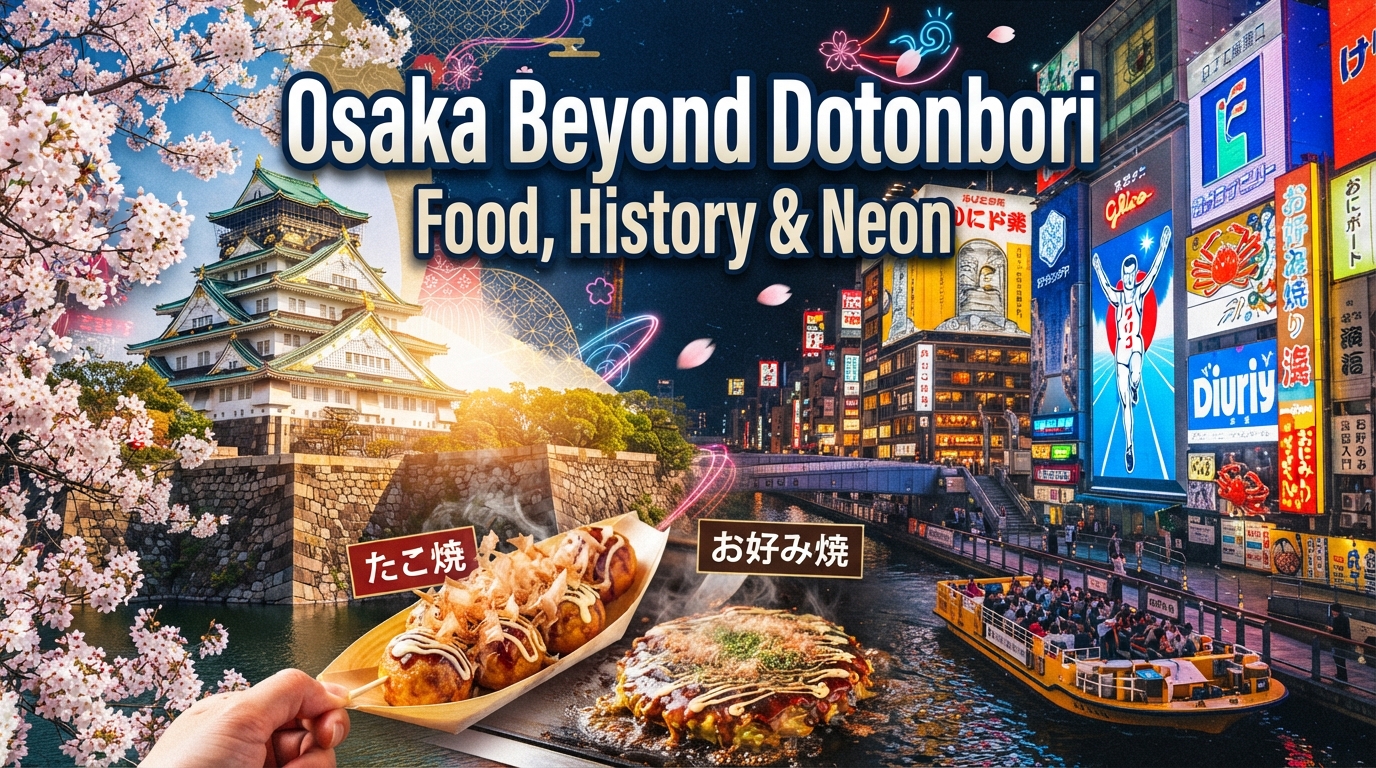
If Kyoto is where Japan slows down to show you its past, Osaka is where it grabs you by the sleeve and says “come eat.” Most visitors treat it as Kyoto’s louder neighbor ? a day trip for takoyaki and neon signs before heading back to the temples. That’s a mistake. Osaka has its own 1,400-year history, its own architectural drama, and since the 2025 World Expo, its own fresh momentum that’s still reshaping the city.
This guide breaks down Osaka’s major sights with the historical context most travel guides skip, plus a realistic sense of how much time each place actually deserves.
A City Built on Contrast
Kyoto was Japan’s imperial capital for over a thousand years. Osaka, by contrast, built its identity as a merchant city ? a place where commerce, not court politics, called the shots. That history still shows: locals are famously more direct, haggling over prices was once totally normal, and the local dialect (Osaka-ben) carries a warmth and humor that’s noticeably different from the reserved formality you’ll find in Kyoto. Keep that contrast in mind as you move through the city ? it explains a lot about why Osaka feels different, not just looks different.
Major Sights and the History Behind Them
Osaka Castle
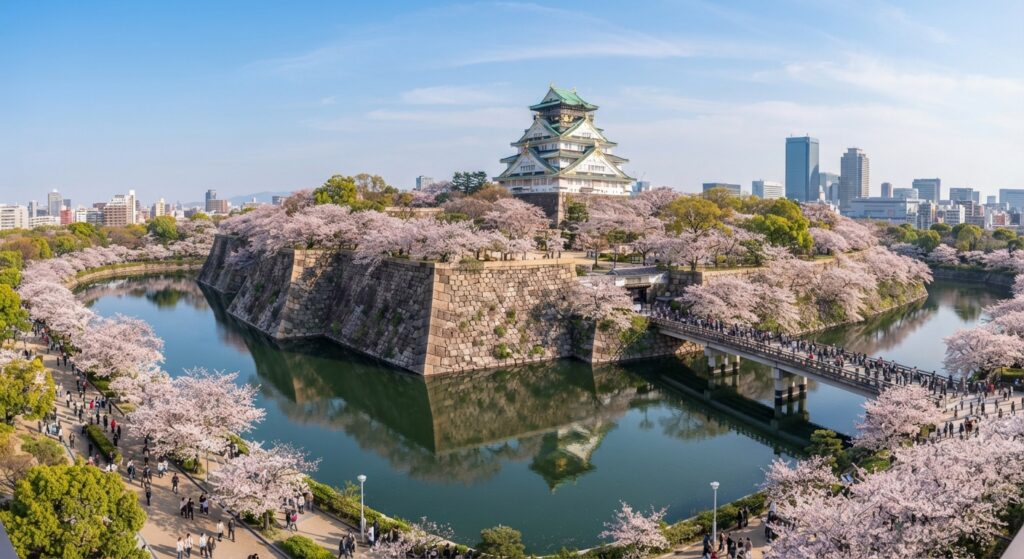
Built in 1583 by Toyotoyotomi Hideyoshi, one of the warlords who unified Japan, the castle was a statement of raw power ? its stone walls were among the largest ever constructed in the country at the time. It didn’t stay standing, though: the castle was destroyed during the Siege of Osaka (1614?1615) when Tokugawa forces defeated the Toyotomi clan, and was later rebuilt under Tokugawa rule. What you’ll actually climb today is a 1931 reinforced-concrete reconstruction with a museum inside ? worth knowing before you go in expecting centuries-old wooden interiors. The castle grounds themselves, with their moats and stone walls, are original enough to give a real sense of scale.
Time to budget: 1.5?2 hours, more during cherry blossom season when the surrounding park gets crowded and photogenic.
Dotonbori
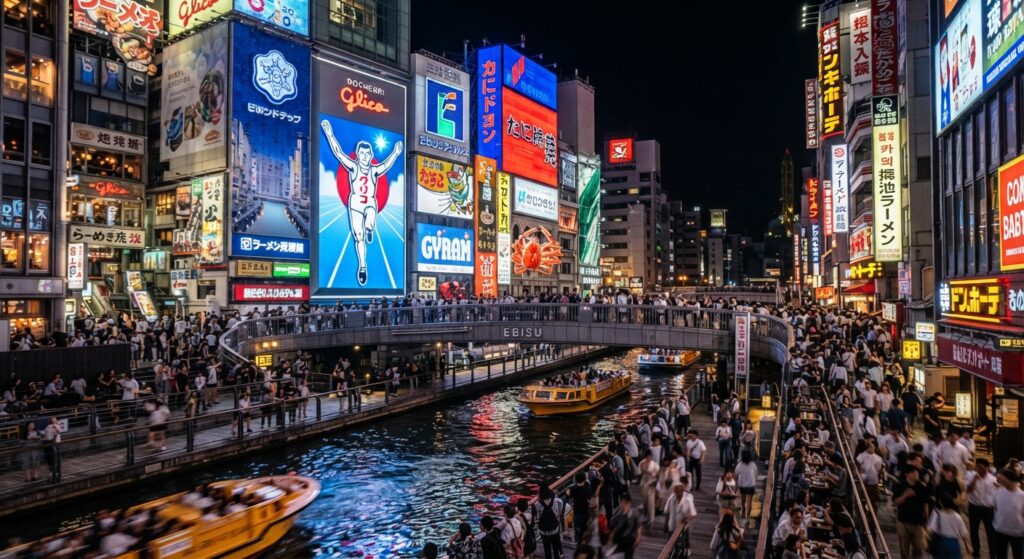
Osaka’s most photographed street started as a canal, dug in 1612 to improve trade access. By the Edo period it had become a theater district, lined with kabuki and bunraku puppet theaters ? the birthplace of Osaka’s reputation as a city obsessed with entertainment and food. The iconic Glico running man sign has been lighting up the canal since 1935, making it one of the longest-running pieces of advertising in Japan. This is where the phrase “kuidaore” (eat until you drop) comes from, and it’s still the best place to understand what that means in practice.
Time to budget: 2?3 hours in the evening, when the signage and crowds are at their best.
Shitennoji Temple
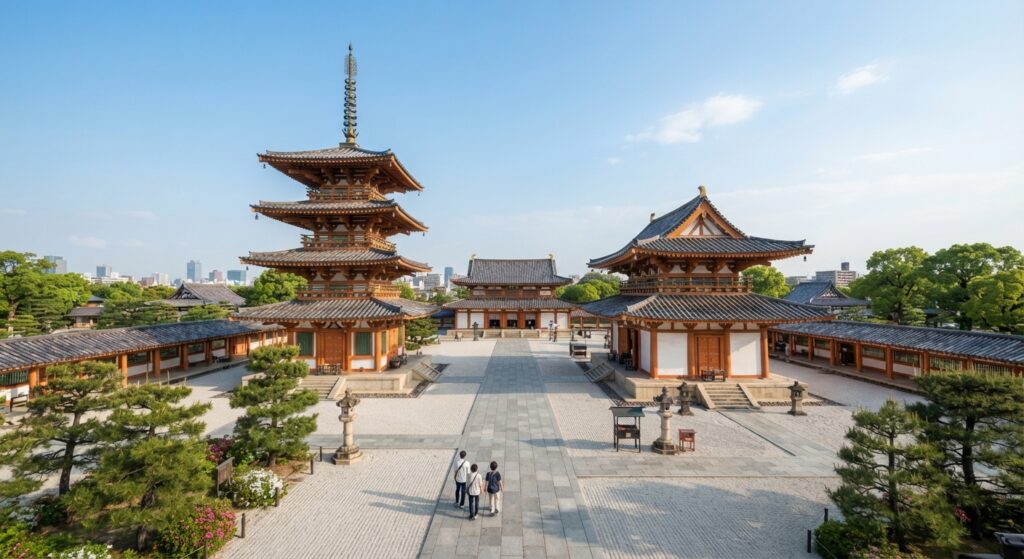
Built in 593 CE on the orders of Prince Shotoku, Shitennoji is one of Japan’s oldest officially administered temples ? older than most of what you’ll see in Kyoto. It’s a useful fact to drop on visitors who assume Osaka is a purely modern, commerce-driven city: this is where organized Buddhism in Japan effectively got its start. The temple has burned down and been rebuilt multiple times over the centuries, most recently after WWII bombing, but its layout still follows the original 6th-century design.
Time to budget: 1 hour. Less crowded than Osaka Castle, which makes it a good counter-programming stop.
Shinsekai and Tsutenkaku Tower
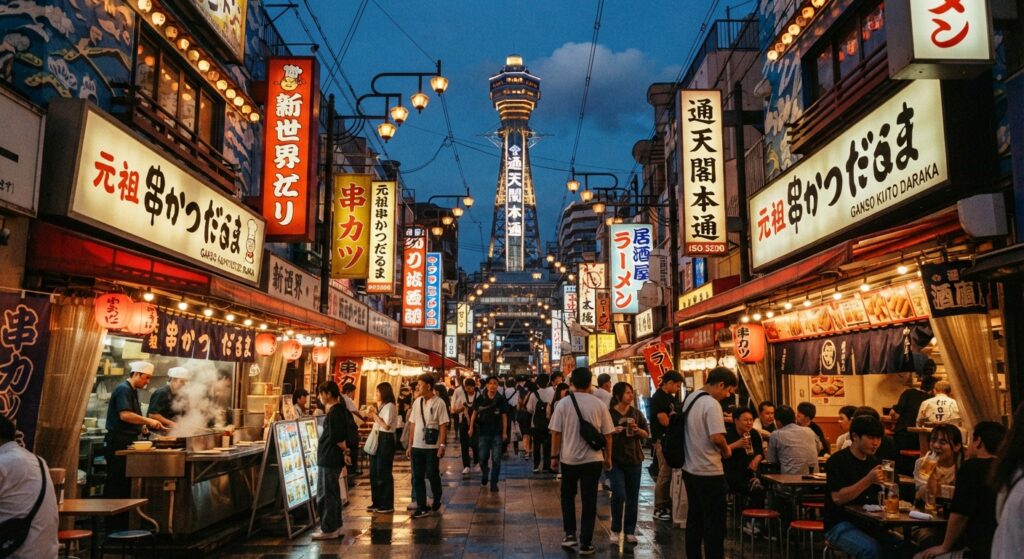
Built in 1912, modeled loosely on the Eiffel Tower and New York’s Coney Island, Shinsekai (“New World”) was Osaka’s vision of a modern entertainment district for the 20th century. The original tower burned down in 1943; the current one dates to 1956. The neighborhood’s slightly rough, nostalgic edge ? string lights, kushikatsu stalls, old-school pachinko parlors ? isn’t an accident. It’s the same entertainment-district instinct that built Dotonbori, just a different era’s version of it.
Time to budget: 1.5 hours, ideally around dinner for kushikatsu.
Umeda / Umekita
For contrast, Umeda is where Osaka shows its future instead of its past. The Umekita 2-ku redevelopment, which fully opened in 2024, turned former rail yards into a park-and-tower district right next to Osaka Station ? part of the broader wave of investment the city has seen heading into and following the 2025 Expo. It’s not historic, but it’s worth including precisely because it shows a different side of the city than the castle-and-canal itinerary.
Time to budget: 1?1.5 hours, easy to combine with a train transfer.
Suggested Route by Traveler Type
| Area | Time Needed | Best For | Historical Hook |
|---|---|---|---|
| Osaka Castle | 1.5?2 hrs | First-time visitors, history-focused travelers | 1583 founding, Siege of Osaka |
| Dotonbori | 2?3 hrs (evening) | Food-focused travelers, first night in the city | 1612 canal, Edo-era theater district |
| Shitennoji Temple | 1 hr | Travelers who did the Kyoto temple circuit and want more depth | 593 CE, pre-dates most Kyoto temples |
| Shinsekai/Tsutenkaku | 1.5 hrs | Travelers who want a less-polished, local-feeling neighborhood | 1912 origins, Showa-era nostalgia |
| Umeda/Umekita | 1?1.5 hrs | Travelers curious about modern Osaka, transit-adjacent stops | Post-Expo redevelopment |
A comfortable two-day itinerary would pair Osaka Castle with Shitennoji on day one (both lean historical), and Dotonbori with Shinsekai on day two evening (both lean food and nightlife), leaving Umeda as a flexible add-on around train transfers.
Local Culture and Etiquette
- Street food eating: Dotonbori and Shinsekai are generally tolerant of eating while walking, unlike many other parts of Japan where this is considered poor manners. That said, it’s still polite to step to the side rather than block foot traffic, and to dispose of skewers/wrappers properly ? trash cans can be scarce, so it’s common to carry your trash for a bit.
- Bargaining: Osaka’s merchant-city reputation includes a history of price negotiation, but don’t expect this at modern retail or chain restaurants ? it survives mostly in small, independent shops and markets, and even there it’s faded significantly from its historical peak.
- Directness: Osaka locals are often more talkative and quicker to joke with strangers than in other parts of Japan. Don’t mistake this for rudeness ? it’s a genuine regional trait, and initiating small talk back is generally well received.
FAQ
How many days do you need in Osaka?
Two full days covers the major sights comfortably. One day is workable if you’re combining it with a Kyoto trip and prioritizing just Osaka Castle and Dotonbori.
Should I visit Kyoto or Osaka first?
There’s no wrong order, but many travelers find it works well to do Kyoto first (slower pace, more walking-heavy) and treat Osaka as the higher-energy close to the trip. If food is a priority, ending in Osaka means finishing on a high note.
Is Osaka Castle’s tower the original building?
No ? the current tower is a 1931 reconstruction with modern museum facilities inside. The surrounding stone walls and moats are much closer to the original 16th?17th century structure.
What happened to the 2025 Expo site?
[Internal note: needs direct verification before publishing ? confirm current post-Expo status of the Yumeshima site before this FAQ answer is finalized.]
What food should I not skip in Osaka?
Takoyaki, okonomiyaki, and kushikatsu are the three most associated with the city specifically ? all three are easy to find around Dotonbori and Shinsekai.
comment